(In the 1990s that four-way
partnership ended and the Lums are the dealership sole owners.)
Dave and wife, Shirley -- married
Aug. 17, 1958 -- are known for their community commitment and community service
to Astoria and Clatsop County and its citizens.
Lum's Auto Center is now
under the leadership of Dave and Shirley's daughters Lori, Julie and Pam.
The Auto Center is now
located in Warrenton, about six miles from Astoria.
An outstanding athlete at
Astoria High School (Class of 1952), Dave attended Linfield with aspiration to
be a teacher and coach. His Linfield student activities included playing
football (quarterback), basketball and golf for the Wildcats.
After graduating
from Linfield he taught and coached at eastern Oregon's Echo High School in
Umatilla County. Echo is about 22 miles from Pendleton.
He was at Echo High the school years of 1958-1959, 1959-1960 and 1960-1961.
Later he left
teaching/coaching and was in the insurance business and car sales in Portland.
This was all before moving back to Astoria and opening the auto dealership.
In late 2018 Lum’s purchased
McMinnville's Larsen Motor Co. (See story below from McMinnville News-Register)
It will be renamed Lum Motor Co.
:::::::::::::::
Larsen Motors sold to
Warrenton car dealer family
By David Bates, McMinnville N-R, Dec 13, 2018, online, Dec
14, 2018 print
Larsen Motor Company, one of
McMinnville’s oldest family-owned businesses, has handed the keys over to new
owners, ending a 78-year run in the car-selling business that grew out of a
downtown service station in the 1930s.
Brothers Scott and Allan
Larsen, who assumed command of the dealership from their father Herm Larsen
around 1980, said Wednesday they’ve sold their General Motors franchise to the
car dealership family of David Lum of Astoria/Warrenton.
Lum, who acquired his
teaching degree from Linfield College, has operated Lum’s Toyota in the Clatsop
County city near Astoria for half a century. It is now run by his daughters,
Lori, Julie and Pam Lum. Lori is the new principal owner, and Pam Lum will move
to the area to assume the role of operating manager.
“We are honored to acquire
this franchise from the Larsen brothers who are so deeply rooted in the
McMinnville area.” We are so excited to be part of this wonderful community.”
The family is also
transferring a sales manager of 28 years, George Kurns, who will be the
McMinnville dealership’s new general manager.
The sale was brokered by
Performance Brokerage Service, a California-based company, and on Wednesday the
signing of the official papers made the transaction final.
“They’re being signed as we
speak, that’s what’s happening today,” Scott Larsen said. “We spent our time
today with the Lums and the banks and General Motors. The Lums officially take
over at 6 o’clock tonight.”
“It’s quite a day,” said
Allan Larsen, the elder son of Herm, who died in 1996. “My brother and I, and
our father of course, before, basically spent our working lives here, and this
is the 78th year that we’ve been in business in McMinnville.
“It’s going to be a really
big change for us, but we’re really happy with the people that are coming
behind us,” he said. “We think they’re going to be great for McMinnville, we
really do. It’s a good family, and very community-minded and employee- and
customer-minded so the place is going to be in good hands.”
Larsen Motor Company’s story
began in the 1930s when Herm Larsen went to work for Gale Vinton at a Shell
station on the corner of Third and Baker streets. In 1940, they formed a
partnership to sell Buick cars and GMC trucks. The company later moved east to
the parking lot area across from Macy & Son’s Funeral Directors, before
moving to its current location at 830 N.E. Highway 99W in 1958.
Scott Larsen recalled when
he and Allan were young and would wash cars and handle other odd jobs at the
dealership during the summers. After attending college, they returned to
McMinnville to take over the family business.
Both said it’s too early to
know what retirement holds. Allan plans to spend more time at home for a while,
but intends to remain active in the community and perhaps travel.
“We just need a break for a
little while to find that out,” Scott Larsen said. “My plan is not to stay home
and watch TV, I can tell you that.”
The business, which employs
about 30 people, will become Lum Motor Company. A grand re-opening is likely at
some point, Scott said.
::::::::::::::
Lum featured in Time ad
(Source: Linfield Magazine, Summer 2009)
David Lum ’58 could have
sold timber cleared for his new car dealership in Warrenton for several
thousand dollars. Instead, he donated the 12 spruce trees to the Oregon
Department of Fish and Wildlife to help restore habitat for coho salmon and
other fish on Hawley Creek, a tributary of the Necanicum River.
“In the old days they used
to clean up fallen trees from streams,” Lum said, “but they found the salmon
couldn’t hatch. It was not environmentally friendly. So they’ve got to put
trees back in and make places where they can lay eggs without them washing
away.”
Lum’s stream-restoration
contribution was described in a full-page ad in the Sept. 1 Time magazine. The
ad notes that he received the Toyota President’s Award for the fourth year in
2008. The award recognizes not only outstanding sales and service, but also
community involvement.
Besides Toyota/Scion, the
Lums sell Chrysler, Dodge, Jeep, GMC, GM and Pontiac products. Lum officially
retired eight years ago, and his two daughters now run Lum’s Auto Center.
Recently Lum attended his
50-year Linfield reunion. “I’m so proud to be a Linfield graduate,” he said.
“In my self-assessment I wasn’t college material, but I got through Linfield
because I got a lot of help. I’m a motivation for all my classmates,” he joked.
“Life isn’t about how much money you have – it’s about friends and family, and you can learn more from Linfield than any other school I can think of. It teaches you more than the basics – you get an appreciation of life and health and everything else."
July
30, 2012, Astorian about Astoria High School Class of 1952 members:
=We had a great football team,” said classmate David Lum,
owner of Lum’s Auto Center in Warrenton, who played quarterback behind fellow
class member Jerry Gustafson.”
July
30, 2012, Astorian:
=Lum’s father emigrated from China in 1904, and his mother
was an American-born Chinese from California. His parents owned Lum Grocery
Store on Sixth and Bond streets. As the youngest of six siblings, Lum said his
parents sacrificed a lot for them.
=“The kids of my class were under the same scenario that I
was. There were no well-off families. We were all not even blue-collar. So the
adversity I overcame, all my classmates did too,” he said. “Everybody lived on
the skinny. ... I remember going to someone’s house and eating beans. That’s
the way it was. I mean, I didn’t think anyone was poor – we didn’t know.”
=After high school, Lum attended Linfield College. For Lum,
1958 was a big year: he graduated from college in the spring, got married in
the summer and started teaching in the fall.
=He spent three years at Echo High School, near Pendleton,
teaching classes in typing and math as well as coaching sports teams. But it
was difficult to support a growing family on a teacher’s salary.
=“There was adversity, and I overcame it,” he said simply, preferring
not to focus on it. “I can tell you, the struggle to get a job, and in 1963
they had to hire minorities, but why talk about it?”
=A self-professed believer in lifelong learning, Lum changed
careers, spending the next seven years in Portland selling insurance and cars.
=“To be good in any profession, you have to keep going,” he
said.
=In 1969 Lum moved back to Astoria and founded Lum’s Auto
Center in Warrenton with three partners. The partners split in the 1990s, and
Lum has remained in the Astoria area, where his three daughters, all graduates
of AHS, help run the auto center. He and his wife have four children and 10
grandchildren.
=“I mainly brought my kids back here because I always was so
accepted here,” Lum said of returning to his hometown.
=In 2010 Lum’s Auto Center received Excellence in Family
Business awards by Oregon State University. Lum was the 2011 recipient of the
Astoria-Warrenton Chamber of Commerce’s George Award, and he has helped develop
the Astoria Riverfront Trolley and contributed to the renovations of the
Astoria Column.=iri
April
1, 2010 Astorian:
=Most people know David Lum as the founder of the successful
Toyota dealership and family business Lum's Auto in Warrenton.
=If you stop by the dealership these days, you might catch a
glimpse of this gracious entrepreneur, with his loyal dachshund, Clara, always
by his side.
=Lum retired about a decade ago, but still keeps an office
in the building. His three daughters Julie, Lori and Pamela help run the
business these days.
=But while Lum's prosperous dealership has become a
Warrenton fixture, his family's roots go way back in the Astoria community,
where his auto dealership also began.
Lum, the youngest of six children, was born in Astoria in
1933 at the hospital on 16th Street which is now the site of Clatsop Care
Center. His family ran the Lum Quing Grocery store for many years, a business
that was formerly located at Bond and 6th streets in Astoria. That building
later became the site of Lum's Auto dealership, and more recently housed a cell
phone dealer.
=Lum graduated from Astoria High School and attended
Linfield College. He said his mother, whom he referred to as a
"pillar" of the Baptist church in =Astoria, has been a big influence
in his life, reinforcing his values and insisting that he get an education.
=By 1958, Lum had graduated from college, married his wife
Shirley, and was teaching at Echo High School near Hermiston, Ore. A few years
later the couple moved to Portland, and he embarked on a career in a field he
felt drawn to - the world of business.
="I enjoy sales," Lum said. "I'm a people
person."
=He sold cars and insurance before ultimately opening his
own Toyota dealership in Astoria in 1969.
=Over 40 years later, Lum's is now located in a new, elegant
Toyota auto center in Warrenton near Home Depot.
=During his career, Lum has been honored with numerous
awards. Perhaps the best known is the Time Magazine Quality Dealer Award, a
prestigious honor in the auto sales industry. He received the award in 2006.
=Lum said he's been fortunate to have done well in business
over the years, and noted that retirement has turned out to be different from
what he imagined.
="All my life I thought one of these days I'd like to
do nothing," he said. "But then you retire and after two or three
months you think, 'What am I doing?'"
=Lum's daughter Pamela, who stopped by during the interview,
pointed to a "to do" list on her dad's desk that includes some
intensive projects - among them learning Chinese and Spanish. Despite his
family's long Chinese heritage in the region, he never learned the language.
=Lum shared four important keys to success that have served
him well:
="Do what you're told, stay out of trouble," he
said, referring to his family's tradition of honoring parents' guidance for
their children. "Then arrive early and stay late."
=Lum has certainly done all of these things in his life,
especially the arriving early and staying late part, as he methodically built
his business from startup to successful enterprise.
=He continues to be involved in issues at the dealership and
elsewhere.
="I still feel that I'm not through with my life,"
Lum said. "Everyone wants to feel needed and valued. There is lots more to
learn."
David Lum named Regatta admiral
Story
in May 21, 2004 Astorian:
The Astoria Regatta Association announces this year's 2004
Admiral - David Lum.
Lum's personal and professional commitment to the Regatta
and the city has insured that the Regatta continues as the longest running
festival west of the Mississippi. The Regatta will celebrate its 110th year
this August 10 through 15. This year's theme "A Journey to Remember"
lends itself to the Lewis and Clark journey on the Columbia River and to Lum's
long journey of support for the Regatta. It is with great pleasure the
association can now add Admiral David Lum to the Regatta history books.
Lum is a true native Astorian. He was born in Astoria and is
a graduate of Astoria High School. He then attended Linfield College and upon
graduation, became a high school teacher and coach in Echo.
He married Shirley Lee.
In 1969, they moved back to Astoria to raise a growing
family and start an automobile business. Currently, Lum is the owner of Lum's
Auto Center, which includes franchises of Toyota, Scion, Chrysler, Jeep, Dodge,
GMC and Pontiac. His growing family comprises of his wife of over 45 years,
four children, six grandchildren with seven more on the way.
Lum's professional achievements included being the president
of the Oregon Auto Dealers Association; a member of the Board of Directors of
the N.W. Toyota Dealers Association; past president of the Astoria Chamber of
Commerce; and received the Minority Business Family of the Year award in 2000
from Oregon State University.
He is a member of the Astoria First Baptists Church, the
Astoria Country Club and the Elks, Eagles and Moose lodges.
--An Associated Press story in the Sept. 1, 1959 Oregonian reported that Dave Lum was hired as Echo High School's basketball and baseball coach.
--In its Oct. 2, 1955, edition, the Oregonian said Dave Lum threw a second period 12-yard touchdown pass to Jim Cousin to help Linfield's JV football team beat George Fox, 13-7.
Linfield
Jayvees Tip 'Cats, 14-0
(Source:
Sept 30, 1952, Medford Mail Tribune)
McMINNVILLE -- Linfield college junior varsity defeated
Willamette university JV's 14-0, here Monday in a football game. Linfield
scored in the first and third periods, the first touchdown coming on a
five-yard pass from Quarterback Dave Lum, former Astoria high school player, to
End Bill Gearin and the second score on a two-yard plunge over center by
Fullback Bill McClaren.
Links to stories about the Lums:
::::::::::::::::::::::::::::
David Lum
By Joanne Rideout,
Daily Astorian, Astoria, Oregon, March 31, 2010 Updated December 7, 2018
Most people know David Lum as the founder of the successful
Toyota dealership and family business Lum's Auto in Warrenton.
If you stop by the dealership these days, you might catch a
glimpse of this gracious entrepreneur, with his loyal dachshund, Clara, always
by his side.
Lum retired about a decade ago, but still keeps an office in the
building. His three daughters Julie, Lori and Pamela help run the business
these days.
But while Lum's prosperous dealership has become a Warrenton
fixture, his family's roots go way back in the Astoria community, where his
auto dealership also began.
Lum, the youngest of six children, was born in Astoria in 1933 at
the hospital on 16th Street which is now the site of Clatsop Care Center. His
family ran the Lum Quing Grocery store for many years, a business that was
formerly located at Bond and 6th streets in Astoria. That building later became
the site of Lum's Auto dealership, and more recently housed a cell phone
dealer.
Lum graduated from Astoria High School and attended Linfield
College. He said his mother, whom he referred to as a "pillar" of the
Baptist church in Astoria, has been a big influence in his life, reinforcing
his values and insisting that he get an education.
By 1958, Lum had graduated from college, married his wife
Shirley, and was teaching at Echo High School near Hermiston, Ore. A few years
later the couple moved to Portland, and he embarked on a career in a field he
felt drawn to - the world of business.
"I enjoy sales," Lum said. "I'm a people
person."
He sold cars and insurance before ultimately opening his own
Toyota dealership in Astoria in 1969.
Over 40 years later, Lum's is now located in a new, elegant
Toyota auto center in Warrenton near Home Depot.
During his career, Lum has been honored with numerous awards.
Perhaps the best known is the Time Magazine Quality Dealer Award, a prestigious
honor in the auto sales industry. He received the award in 2006.
Lum said he's been fortunate to have done well in business over
the years, and noted that retirement has turned out to be different from what
he imagined.
"All my life I thought one of these days I'd like to do
nothing," he said. "But then you retire and after two or three months
you think, 'What am I doing?'"
Lum's daughter Pamela, who stopped by during the interview,
pointed to a "to do" list on her dad's desk that includes some
intensive projects - among them learning Chinese and Spanish. Despite his
family's long Chinese heritage in the region, he never learned the language.
Lum shared four important keys to success that have served him
well:
"Do what you're told, stay out of trouble," he said,
referring to his family's tradition of honoring parents' guidance for their
children. "Then arrive early and stay late."
Lum has certainly done all of these things in his life,
especially the arriving early and staying late part, as he methodically built
his business from startup to successful enterprise.
He continues to be involved in issues at the dealership and
elsewhere.
"I still feel that I'm not through with my life," Lum
said. "Everyone wants to feel needed and valued. There is lots more to
learn."
:::::::
Seen from Seaside: What a great ride!
By R.J. Marx, Seaside Signal, Seaside, Oregon, November
13, 2019
David Lum of Lum’s Auto Center is the co-founder of one of the
region’s pre-eminent businesses. Lum’s is celebrating its 50th anniversary this
year. We spoke with Lum at his office above the showroom in Warrenton.
Q: Where were you born?
Lum: Columbia Hospital in Astoria, Oregon. Nov. 19, 1933.
Q: How did your family get here?
Lum: If you look at the history of Astoria, there were 3,000 or
4,000 Chinese. The Irish and Chinese built the railroads in the early 1800s.
All the Chinese in this area came from the “Supreme Province,”
the province of Canton. Now they’ve changed the name to Guangdong.
When they built the railroad and they were done, then the
Chinese either went home back to China and were looking for jobs out here.
They were building the jetties, working in the fish canneries. A
lot of them went into the gold mines after the railroad, and they migrated to
that area. They wouldn’t let them dig for gold, but they did all the grunt work
for the goldminers.
Just like the fishing industries. The Chinese didn’t own the
fishing industries or the jetties, but they were hired by the contractors who
built the jetty. Dangerous work, and they were willing to work for less money.
Q: How did your father make a living?
Lum: In those days they didn’t have Safeways, Costcos.
My father had an uncle who owned a little grocery store in
Astoria, Lum-Quing Grocery. We had a couple of grocery stores, one on Sixth and
Bond, for close to 70, 80 years. It’s called Chinatown because most of the
Chinese lived in the area.
Q: How did your mother come into the picture?
Lum: After my father came here in 1896, 10 or 15 years later, my
uncle gave the store to my father.
In those days, it was prohibited for Chinese to marry anyone but
Chinese. My father wanted children, and he was introduced to her by other
Chinese.
She was born in Wheaton, California. My mother didn’t know how
to read or write Chinese. She did not know how to read or write English. She
was a very bright person, but she wasn’t educated.
My mother married my father when she was 15 and he was in his
40s.
I was the last of six kids. I came in 1933, when my dad was 62.
Four or five years later, he had a stroke. He was bedridden for
10, 11 years.
Q: How’d you keep the store going?
Lum: My brother came home. He ran the grocery store.
Q: So you had an All-American childhood in Astoria?
Lum: Yup. I was here from ’33 to the early ’50s. My mother
became a pillar of the First Baptist Church. She learned how to read and write
from the congregation. They taught her to read the Bible.
Q: I heard you were a football star.
Lum: I wasn’t a star.
We were in the state finals when there were just A and B
divisions. Anything under 100 students-and-under was a B school. We had about
300 or 400 kids in Astoria. We played Central Catholic, Portland schools, David
Douglass.
Our starting quarterback went on to Stanford. He played in the
pros. We had an All-American halfback, Dick Pavlat, who was the front cover of
Parade Magazine in 1953.
A guy named Jerry Gustafson went on to play with the 49ers and
the B.C. Lions.
Q: What was it like growing up here?
Lum: God bless I was born in America.
It’s the relationship you have with your classmates and your
teachers. The teachers wanted me to learn. I was kind of the underdog.
I was taught to be very respectful. Everyone was “Mr.” or “Mrs.”
I had people help me who didn’t even know me very well.
I have to be more blunt than this. I was Chinese, I was different,
I was thrown into white society, one of the few. There were a few Chinese kids,
but mainly we were a minority.
My big thing was to have people like me. I was very respectful
to the elders. We’d avoid fights. My folks taught us life’s too valuable. I may
not agree with you, but I’ll listen to you.
Q: What were you next steps after high school?
Lum: I went on to Linfield College.
I became only the second Chinese teacher in the state of Oregon.
There was one elementary teacher who got a job before I did. She’s still alive.
She’s 93.
Q: Tell me about your teaching years.
Lum: I taught at a high school in Echo, Oregon, near Pendleton.
My first job was $3,750 a year. I knew I wanted children. I knew we could maybe
have one (on my salary). If my wife worked, we could just make it.
Q: So you left teaching in order to raise a family?
Lum: I became a busboy. I was a waiter, a bartender, sold
insurance.
Q: How did you make the jump to auto sales?
Lum: Roger Riutta owned a little gas station and we were buddies
in high school. He had a partner, Tom Utti. The three of us got together and we
started building up. I was 35, Tommy was 25.
Q: What year was that?
Lum: Fifty years ago, in 1969. This is our 50th year.
Q: In the Warrenton location?
Lum: We’ve only had this 10 years. We started right where the
grocery store was on Sixth and Bond.
Q: You sold Toyota vehicles only?
Lum: Yes, Toyota since 1969. In 1978 we bought Johnson Motor on
16th Street. It was a Pontiac General Motors store. In 1984, we started with
Chrysler. In 1990 we got the Jeep line.
When Roger died, we bought his wife out.
At that point in time, we owned some property in Astoria and
some property in Seaside, Funland. Tommy and I split in the early ’90s. He took
Seaside and I stayed in Astoria.
Q: Were you a natural salesman? Were you prepared?
Lum: I was not prepared for anything. But teaching helped.
At first I have to admit everybody gets in business for money,
you do almost anything, except cheat people. After a while it isn’t about
money, it’s about what you want to do for society. You care for other people.
Q: How did you develop your sales technique?
Lum: Mr. Toyota, president of Toyota, said, “Mr. Lum, we are
going to make the best cars in the world, and the only way we can do that is if
each of you dealers become the No. 1 dealer in your community. That’s the only
way we can make it.”
Q: Were you successful from the start?
Lum: No, it was a real struggle. The veterans wouldn’t buy
Toyotas — the Japanese were our enemies, My Chinese relatives wouldn’t buy —
Japanese were their enemies.
I think they caught on that we were willing to give back a fair
share. Our goal was to be here forever, to build for our children and their
children, not for profits, but opportunities.
During the ’70s, Toyotas were becoming popular. The whole
atmosphere changed.
Q: Tell me about your family.
Lum: Wife, Shirley, married 60 years. Same house, same spouse.
Three daughters and a son, a high-test librarian at Jesuit High
School, prep school. He’s highly respected.
Q: How often do you come into the office?
Lum: Five days. Every day. That’s because I’ve got a bathroom
with a shower. Very nice.
Q: Any regrets over the years?
Lum: I used to be sad that I was not born white and that I was
born in Astoria. I used to cry, “How come I look different? I’m Chinese, I’ve
got slant eyes.”
There’s been a lot of negative things that happened in my life.
Not everything’s rosy. When I was 12 years old, my dad died.
I use a softer term than discrimination — we were suppressed. We
were held back a little bit. In spite of that, if you look at the opportunities
in America, it’s wide open.
My mother was 47, she had two children 12 and 15, she had no
Social Security, she didn’t know how to read or write Chinese, she didn’t know
how to read English — and we both graduated college. My older sisters both
became RNs. You can be anything you want to be.
Q: Anything else you would like to share?
Lum: I value all my friendships. Every time I see somebody
that’s gone through my life, I always say — and I really mean it — “I’m sure
glad you came into my life.” I’m so thankful because everybody’s just been
super kind, super nice. The big turn-on for me is helping other people.
:::
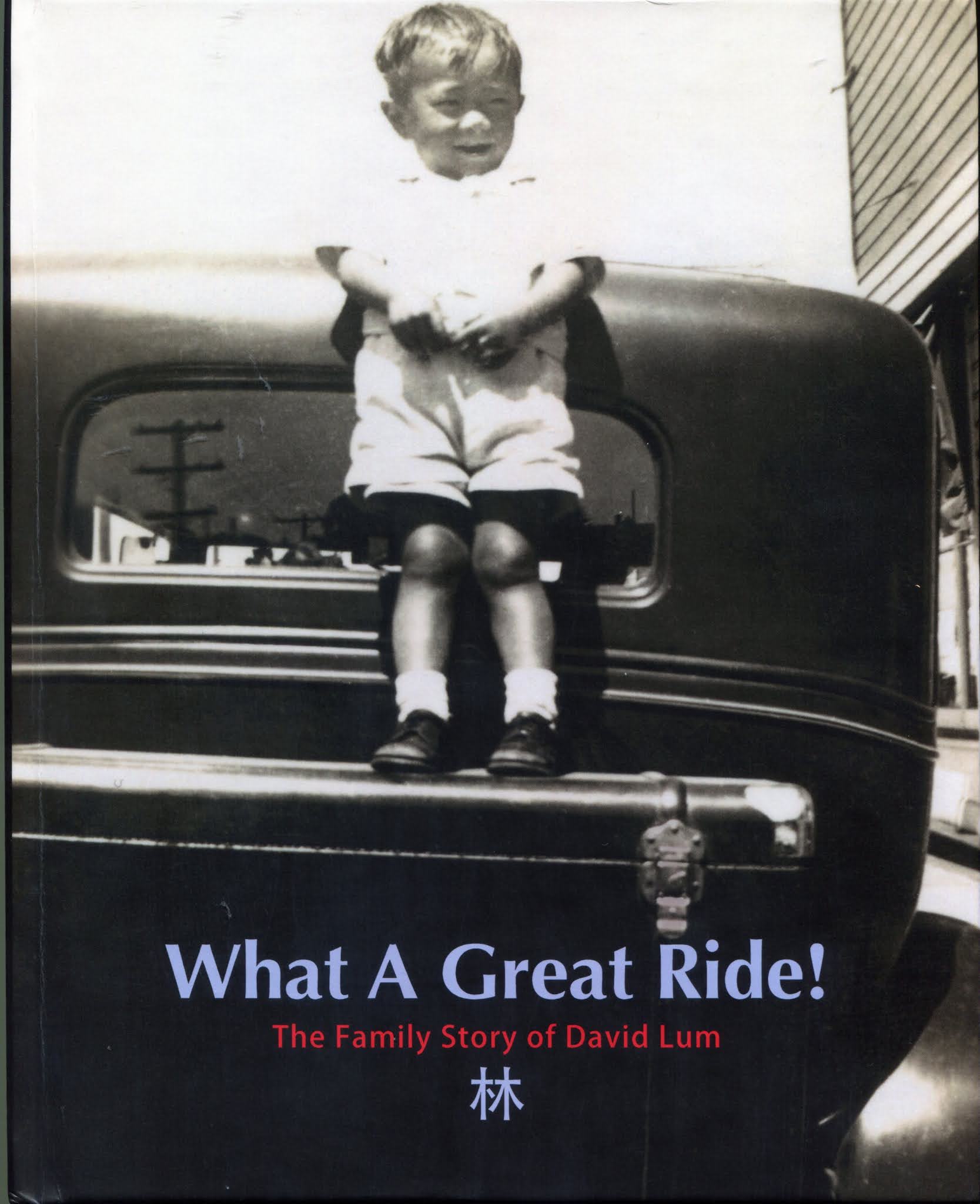
‘What a great
ride; the family story of David Lum’
Hardcover book
(124-pages) by David Lum (Author)
with Michael L. Marlitt. Edited by Beverly Warren-Leigh
Publisher: Timelines, Inc.,
Portland, Ore. (Jan. 1, 2014)
ISBN-10: 132026199X
ISBN-13: 978-1320261999
:::::::::::::::::::
Read about Dave and Shirley Lum from Summer 2009 Linfield Magazine